Why Acer and ASUS Were Banned From Selling in Germany: The Nokia Patent Dispute Explained (2026 Update)
In early 2026, one of Europe’s most important tech markets experienced an unexpected shock.
Acer and ASUS — two of the world’s largest laptop and PC manufacturers — were forced to halt direct sales of several products in Germany.
The reason?
A patent dispute with Nokia over video compression technology known as HEVC (H.265).
This wasn’t a supply chain issue.
It wasn’t a recall.
It wasn’t a financial crisis.
It was a legal injunction issued by the Munich I Regional Court.
Here’s what really happened — and why it matters globally.
What Actually Happened?
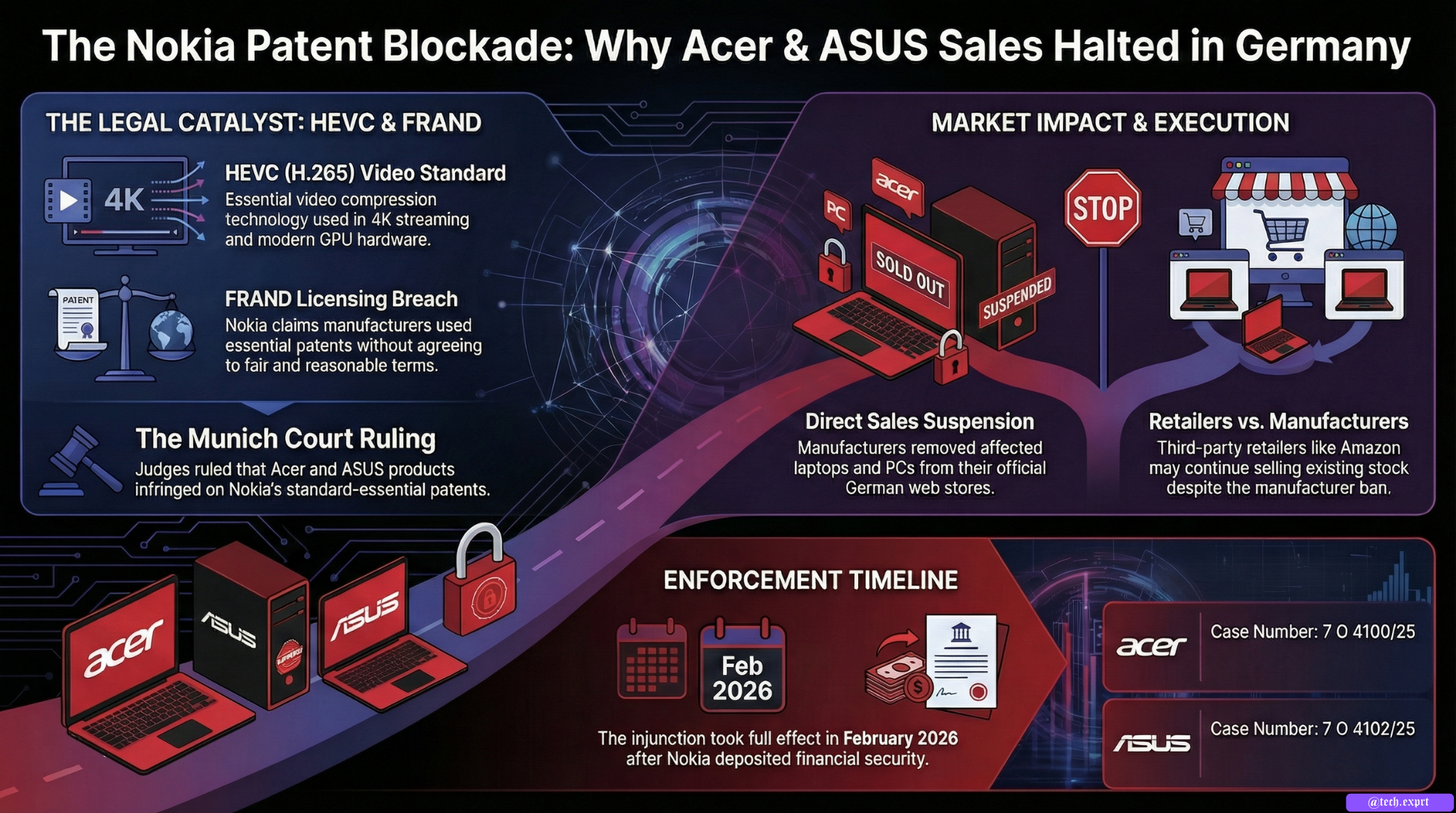
On January 22, 2026, the Munich I Regional Court ruled in favor of Nokia in a patent dispute involving High Efficiency Video Coding (HEVC).
The court determined that certain Acer and ASUS products using HEVC technology infringed Nokia’s patents.
As a result:
• Acer and ASUS were ordered to stop direct sales in Germany
• Their official German websites removed affected PCs and laptops
• Online stores temporarily suspended new shipments
However:
Retailers like Amazon.de and MediaMarkt were not directly banned from selling existing stock.
This distinction is critical.
Understanding the Core Issue: What Is HEVC?
HEVC (High Efficiency Video Coding), also known as H.265, is a video compression standard used in:
• 4K streaming
• Video playback
• Video conferencing
• Graphics processing
• Modern GPUs and CPUs
Most modern laptops and desktops support HEVC decoding at hardware level.
That means nearly every modern PC manufacturer must license HEVC-related patents.
Why Nokia Is Involved
Nokia is no longer just a mobile phone brand.
It is one of the largest patent holders in telecommunications and video compression technologies.
Nokia owns multiple standard-essential patents (SEPs) related to HEVC.
Standard-essential patents mean:
If you implement that standard, you must license it.
Nokia claimed:
Acer and ASUS used HEVC technology without agreeing to licensing terms under FRAND principles.
What Is FRAND?
FRAND stands for:
Fair
Reasonable
And Non-Discriminatory
When a patent is essential to a global standard, companies must license it under FRAND conditions.
Nokia argued that:
• It offered licenses
• Acer and ASUS did not accept the terms
• Therefore, legal action was necessary
The German court agreed with Nokia’s position.
The Legal Timeline
Let’s break it down clearly.
April 2025
Nokia announces legal action against Acer, ASUS, and Hisense for HEVC patent infringement.
Late 2025
Parallel cases proceed in Germany and at the Unified Patent Court (UPC).
January 22, 2026
Munich I Regional Court rules in Nokia’s favor.
Case numbers:
• 7 O 4100/25 (Acer)
• 7 O 4102/25 (ASUS)
Late January 2026
Nokia deposits required financial security to enforce the injunction.
February 2026
Acer and ASUS suspend direct sales in Germany.
What Acer Said
Acer confirmed:
It respects intellectual property and temporarily suspended affected product sales.
The company stated it is exploring legal remedies and potential appeals.
Importantly:
Other product categories like monitors, routers, accessories, and e-mobility devices remain unaffected.
What ASUS Said
ASUS issued a public statement confirming:
• Temporary suspension of its official German online store
• The injunction affects certain HEVC-enabled PCs
• After-sales service continues normally
ASUS also confirmed it will pursue legal action.
What Nokia Said
Nokia emphasized:
Litigation was a last resort.
The company stated it remains open to fair licensing agreements and that many competitors have already accepted similar licensing terms.
Nokia framed the case as:
Protecting innovation and intellectual property rights.
Does This Mean Acer & ASUS Are Banned Completely?
No.
This is not a total market ban.
Key clarifications:
• Retailers can still sell existing inventory
• No product recall has been ordered
• Consumers can continue using devices normally
• Only direct manufacturer sales are suspended
However, if the dispute continues long-term:
• Stock shortages could appear
• Pricing could increase
• Market share could shift
Why Germany?
Germany is known for:
• Strong patent enforcement
• Fast injunction procedures
• Favorable legal environment for patent holders
The Munich I court is especially active in tech patent disputes.
Many major technology patent cases in Europe are filed in Germany for this reason.
Market Impact Analysis
This dispute is not just about Acer and ASUS.
It signals something bigger.
1. Patent Enforcement Is Getting Stronger
Companies with standard-essential patents are aggressively enforcing rights.
2. Codec Licensing Is Expensive
Video compression standards like HEVC require complex licensing pools.
Some companies are exploring alternatives like AV1 to reduce dependency.
3. European Market Risk
Europe remains a legally complex region for hardware vendors.
Companies may need stronger licensing compliance strategies.
Could This Spread to Other Countries?
Possibly.
Nokia has filed cases not only in Germany but also at the Unified Patent Court.
If rulings favor Nokia in broader EU jurisdictions, similar injunctions could occur elsewhere.
However, each country has its own enforcement process.
What Happens Next?
There are three possible outcomes:
1. Licensing Agreement
Most likely scenario.
Acer and ASUS reach a settlement and resume sales.
2. Appeal Overturns Decision
Less likely but possible.
3. Long-Term Legal Battle
Would lead to supply shortages and higher prices.
Industry experts believe a negotiated settlement is the most practical solution.
Why This Matters Globally
This case highlights:
• The power of patent law
• The importance of FRAND negotiations
• The business risk of licensing disputes
• The dependency of modern devices on patented standards
For students and tech learners, this is a real-world example of how technology, law, and business intersect.
Final Verdict
Acer and ASUS were not banned due to financial problems.
They were affected by a patent injunction related to HEVC licensing.
Retail sales continue for now, but long-term impact depends on negotiations and appeals.
The situation demonstrates that intellectual property enforcement remains a powerful force in global tech markets.